Skip to Content


Primary and Secondary Robotic Packaging Equipment

Compact, collaborative packaging robots designed for bakery and food manufacturers with limited floor space. Apex packaging cobots handle both primary packaging (raw, unpackaged product) and secondary packaging (packaged product ready for cases and cartons), with tool-less end effector changeovers between product runs.


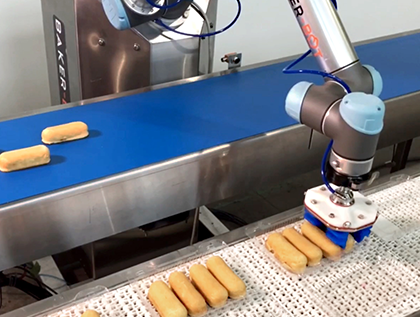
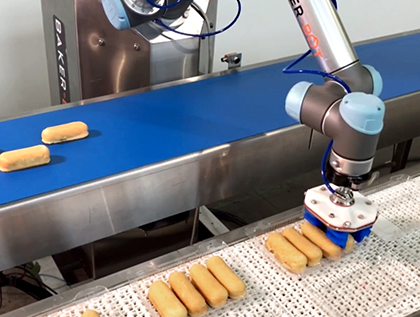
Baker-Bot primary packaging robotic arm

Primary Packaging Robots

Also called pick n place. Handles raw, unpackaged product — bread, chocolates, muffins, buns, cookies, snack cakes and meat products.

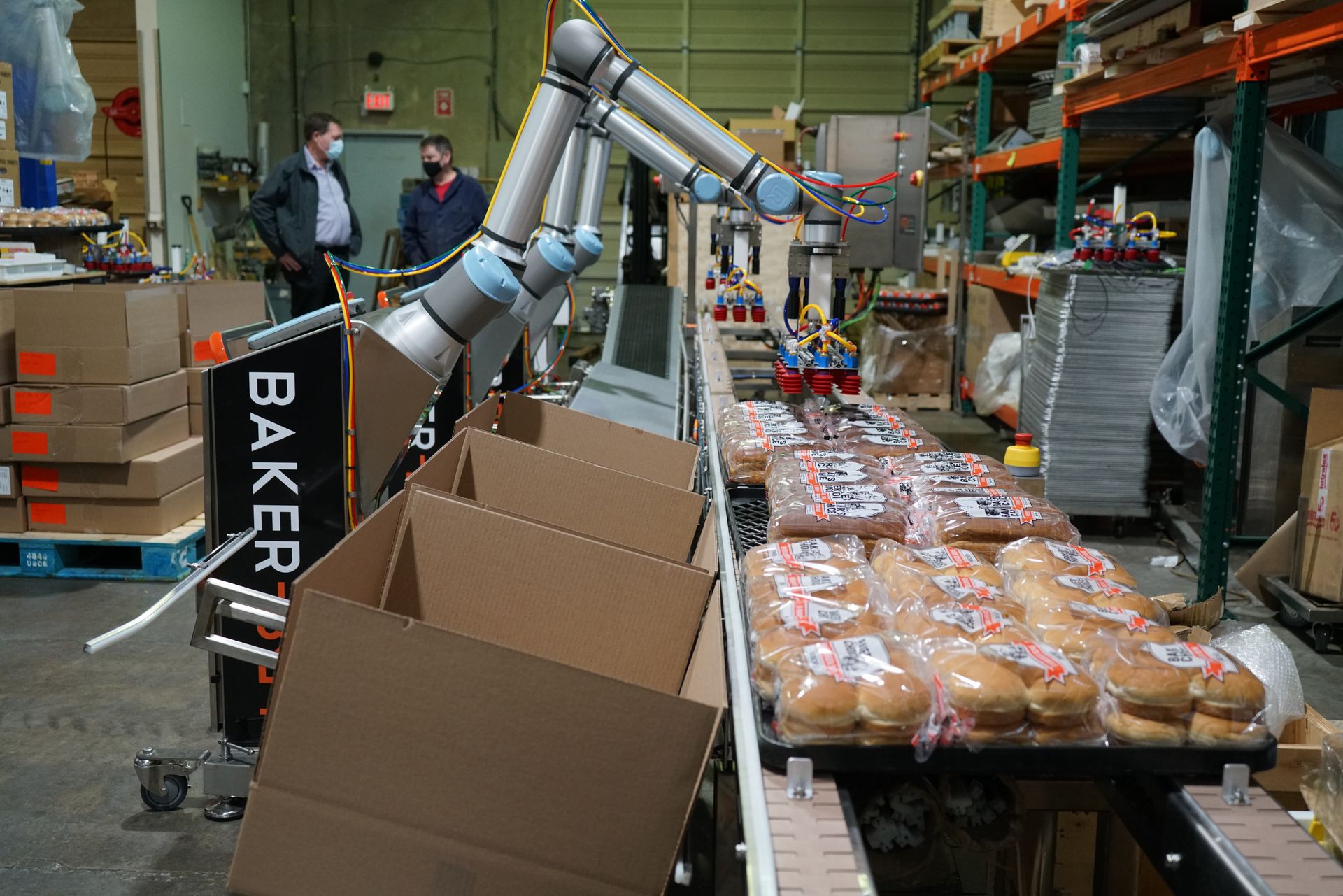
Secondary Packaging Robots

Handles packaged products ready to be placed into 
a box or container — bread, buns, cookies, jugs of protein powder, vitamins and cupcakes in clamshells.


Tool-less End Effectors 

Different applications require different attachments. Apex provides tool-less changeover for attachments including soft gripper heads, vacuum nozzles and multi-head needle grippers


What Is Primary Packaging?

Also known as pick 'n' place, primary packaging refers to handling product before it has been packaged — most commonly post-bake items prepared and ready for retail packaging.

Common primary packaging items: bread, mini chocolates, muffins, buns, cookies, snack cakes, and meat products such as pepperoni sticks, beef jerky and frozen chicken breasts.

End effectors available for primary packaging include soft grip heads and multi-nozzle vacuum heads.

See what equipment works best for this application

What is Secondary Packaging? 

Secondary packaging refers to items that have already been packaged and 
require placement into containers for shipping, such as cardboard boxes.

Common secondary packaging items: bread or buns in bags, clamshells of muffins, buns, cookies, cupcakes, pie or pizza in a box, and individual items such 
as jugs of protein powder, vitamins in small containers or energy drink packages.

End effectors available for secondary packaging include soft grip heads and vacuum grippers sized for cased and cartoned product.

See what equipment works best for this application


Why Should You Automate Packaging with Robotics?

For bakeries and food manufacturers evaluating robotic packaging, Apex Motion Control addresses three common pain points: labor shortages on repetitive packaging lines, limited versatility across product formats, and changeover time between product runs.

Collaborative robots like the Baker-Bot cobot are configurable for a range of formats — from raw, unpackaged product to flow-wrapped single-serve items to multi-pack cartons and case-ready pallets — and integrate into existing lines or deploy as part of a full end-of-line automation strategy.


Key Benefits

  • Removes a repetitive, physically demanding task from staff workloads
  • Handles a variety of products, across size and weight ranges
  • Runs at a consistent pace, reducing variability between shifts and product runs
  • Improves staff retention by shifting workers off physically taxing, low-value tasks
  • Changes over in minutes between product runs with tool-less end effectors

Frequently Asked Questions

Can I run different product runs with the same cobots? Yes. Apex provides a variety of end effectors (attachments) that can be swapped out in a matter of a minute or two.

How fast are collaborative robots for packaging? Cobots typically run at about the same speed as a human worker, but the more important factors are consistency and safety. A human may be faster at some moments and slower at others, while a cobot holds the same pace for the entire shift. Over time, that consistency delivers higher throughput with less downtime. On safety: the repetitive lifting, bending and twisting involved in manual packaging strains the body over hours and days, and over time leads to repetitive motion injuries.

Typos fixed: "humna" → "human"; "overtime" → "over time" (appears twice — "overtime" means paid extra hours, which changes the meaning); "everyday" → "every day."

Are cobots safe to work near employees? Yes. Collaborative robots for packaging, such as the Baker-Bot, are built and programmed to work safely alongside staff.

Can robotic packaging integrate with my existing production line? Yes. Apex packaging cobots integrate into existing lines or deploy as part of a full end-of-line automation strategy alongside palletizing and conveying systems.

New — integration is a top buyer objection and this answer already exists elsewhere on the page. Surfacing it as a Q&A pair makes it extractable.

What products can robotic packaging handle? Bread, buns, muffins, cookies, cupcakes, snack cakes, chocolates, pies and pizzas, plus non-bakery items like protein powder jugs, vitamin containers, energy drink packages and meat products such as pepperoni sticks and beef jerky.


Why Work with Apex Motion Control?

With 25 years of experience helping wholesale industrial bakeries streamline production, Apex helps manufacturers increase throughput, 
consistency and accuracy while planning for future growth.

Equipment benefits:

  • Versatile, modular solutions
  • Reduced repetitive strain for workers
  • Increased productivity and consistency
  • Standard and custom configurations
  • Remote and onsite support & service
  • Easy integration with other OEM equipment


Reach out and let us know what your Packaging Needs Are.


First and Last Name *
Separate email addresses with a comma.

Thank You For Contacting Us

We will review and put you in touch with the best person for your question(s).
In the meantime, keep cruising through our website. .